
St. Lawrence County Criminal Court Cases
St. Lawrence County Court is the regular superior criminal trial court for felony prosecutions. Supreme Court also has broad jurisdiction. Their criminal files connect to the St. Lawrence County Clerk, who serves as clerk of Supreme and County Court. The felony-record core is at 48 Court Street in Canton. A person seeking an indictment, superior-court information, plea, sentence, or certified disposition from one of those courts should start with that clerk rather than the Sheriff.
The lower-court map is broad. Ogdensburg City Court and town or village justice courts hear violations and misdemeanors, conduct arraignments, and handle preliminary felony steps. Those clerks keep their own criminal dockets. A felony can begin in a local court and later move to County Court after grand-jury action. Thus, a St. Lawrence County case search confined to Canton may miss the first docket, while a local-court search may not show the later felony file.
St. Lawrence County Court Map
First identify where the charge sits. The Fourth Judicial District court directory supplies the official St. Lawrence County court list and current contact route. County Court generally receives felony cases that advance beyond the local stage. City, town, and village courts retain matters within their limited criminal jurisdiction. The ticket, appearance notice, accusatory instrument, or online entry may name the right court.
Geography can mislead. An arrest made in Massena, Potsdam, or Ogdensburg does not mean every later paper stays there. A felony prosecution may move to Canton, but an arraignment record remains with the first court. Ask each clerk for the part of the file that office created. The District Attorney's charging work is also distinct from the police narrative. Court records show what was filed and decided, while an arresting agency holds its incident or arrest report.
Note: A police charge, filed charge, and final conviction can be three different entries from the same event.
Searching St. Lawrence County Case Records
WebCriminal offers free guest access to public criminal case and calendar information. It supports defendant-name, case-number, and court-calendar routes. The online view is strongest for active matters and future appearances. It does not prove that no older, closed, sealed, or differently indexed St. Lawrence County criminal case exists. Save the exact court and docket shown before contacting a clerk.
- Open WebCriminal and select a defendant, case-number, or calendar search.
- For a name search, enter at least the first three letters of the last name and first two of the first name, then narrow to St. Lawrence County when the filter appears.
- Compare same-name results by court, docket, filing information, and available case detail. Use the full docket when it is known.
- Read the event list carefully. A future date is not the final disposition, and a filed charge can differ from an arrest charge.
- Request the needed order, accusatory instrument, certificate, or certified copy from the clerk of the court named in the result.
| Field Label | Type | Required | Notes |
|---|---|---|---|
| Search by Defendant | Mode | Choose a route | Starts the name search |
| Last Name | Text | Yes for name route | At least the first three letters |
| First Name | Text | Portal dependent | At least the first two letters in official guidance |
| County and Court | Filters | No | Narrow to St. Lawrence and the likely court |
| Case or Index Number | Text | Yes for number route | Use the full identifier and suffix |
| Security Check | Challenge | When shown | Complete the session check |
St. Lawrence WebCriminal Search
Case numbers are the cleanest route when available. Modern identifiers may resemble CR followed by digits, a two-digit year, and a court suffix. Enter the complete docket rather than trimming the suffix. Calendar searches work through court, courtroom or part, and date. Use the listed part instead of assuming that a judge-name search will find the same St. Lawrence County criminal record.
The portal can show case and court, charges, appearance dates, counsel, and event or outcome fields where reported. Document images are not guaranteed. A missing image calls for a clerk request, not a guess about what was filed. If broader public court coverage is needed, the OCA Criminal History Record Search uses exact name and date of birth and costs $95 per search. CHRS is name based. It is not a fingerprint-matched DCJS rap sheet, and sealed matters are outside its public result.
Inside a St. Lawrence County Case File
A St. Lawrence County criminal case file tracks the prosecution as filed in court. It can preserve the accusatory paper, amendments, scheduled events, motions, pleas, trial events, orders, final outcome, and sentence. The docket is the running index. It helps locate the useful paper, but it may not reproduce that paper online. Ask for a certificate of disposition when the main need is an official statement of the final charge and result.
| Case Number and Court | Identifies the docket and the clerk responsible for the file. |
|---|---|
| Charging Document | States the accusations filed in court, which may differ from booking charges. |
| Docket Entries | Index arraignments, motions, adjournments, pleas, trial events, and orders. |
| Hearing Dates | Show the part, date, time, and stated purpose when public. |
| Disposition | Records dismissal, acquittal, conviction, plea outcome, or another reported result. |
| Sentence | Lists reported jail, prison, probation, discharge, fine, or other components. |
The official County Clerk page is also the source for the assigned St. Lawrence County criminal court image.
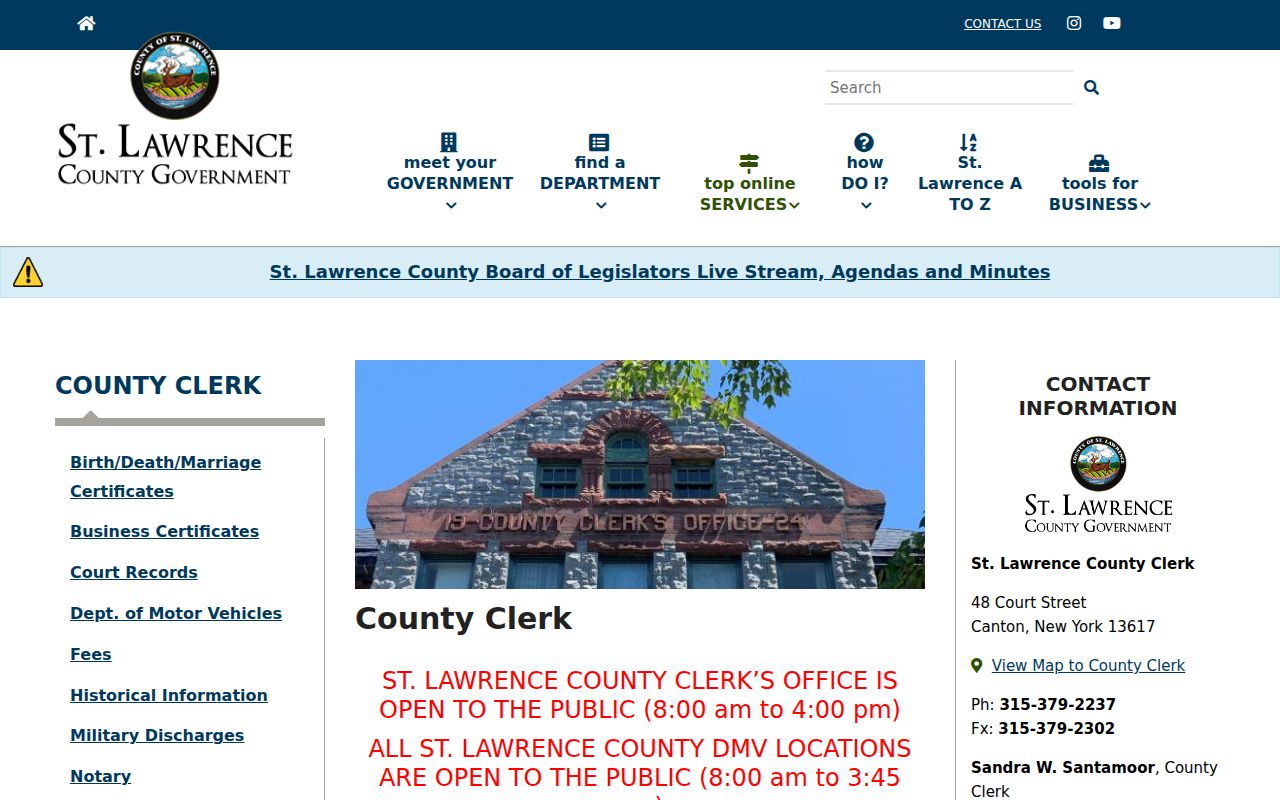
That St. Lawrence County office route matters because superior-court certificates and file copies come from the custodian, not from a jail or police blotter.
St. Lawrence Charging Changes
An arrest report captures what the arresting officer alleged at that stage. The prosecutor may file fewer, different, or revised charges after reviewing the proof. Grand-jury action can then produce an indictment that does not mirror the first booking list. Plea negotiations, motion decisions, trial, or dismissal may alter the final result again. This is why a St. Lawrence County court case file carries more weight for an outcome than an old arrest notice.
Read each charge beside its event date and status. “Arraignment” is the court appearance where the accusation is formally addressed and a plea is taken. A “disposition” is the result of a charge or case. “Adjournment” means the matter was moved to another date, not decided. When an online line is unclear, obtain the disposition from the clerk rather than treating the latest visible charge as a conviction.
Note: The court file answers what prosecutors filed and judges decided; the police report answers what the agency investigated.
How a Criminal Case Moves
A St. Lawrence County criminal case may begin with an accusatory instrument in a local court. The court conducts arraignment and sets the next step. Misdemeanors can remain there. A felony can proceed through preliminary work and grand-jury review before reaching County Court. Pretrial practice may include discovery, motions, hearings, and plea talks. If the case does not end by dismissal or plea, it can move to trial. The clerk records each public stage.
Case flow: Charges Filed › Arraignment › Pretrial › Plea or Trial › Disposition › Sentencing
Not every case uses every stage. Some end early, and sentencing follows only when the outcome calls for it. Dates can also shift. Use the latest court entry and then confirm the result with the court that holds the St. Lawrence County docket.
St. Lawrence Clerk Search Requests
Since June 1, 2024, the St. Lawrence County Clerk requires its fillable Criminal/Civil Search Request form. The criminal search covers the clerk's stated period from 1995 to the present. It asks for requesting agency, date, delivery email, and rows for last name, first name, middle initial, and date of birth. The clerk marks whether a record was found. A “No” speaks only to that search and its scope. It does not establish no arrest or no local justice-court case.
Misdemeanor inquiries are directed to the appropriate local court. Older or archived files may call for a diligent search and certification under Judiciary Law §255. St. Lawrence County Clerk card payments carry a 2.65% surcharge, with a $3 minimum on charges through $100, though the underlying state-set fee schedule can change. Ask for a current cost before ordering. The public counter is at 48 Court Street, Canton, NY 13617, telephone 315-379-2237, with posted hours of 8 a.m. to 4 p.m.
St. Lawrence County Clerk
48 Court Street
Canton, NY 13617
315-379-2237
Posted hours: 8 a.m. to 4 p.m.
St. Lawrence Case Terms
A few terms make a St. Lawrence County docket easier to read. They describe distinct points in the court process and should not be treated as synonyms. The plain meaning also helps separate an open case from a completed one.
- Accusatory instrument
- The formal paper that starts or supports the criminal charge in court.
- Arraignment
- The first formal court response to the charge, including a plea and scheduling.
- Disposition
- The reported outcome of a charge or the case, such as dismissal or conviction.
- Certificate of disposition
- A clerk-certified record of the final court result for the named docket.
A youthful-offender adjudication is not an ordinary public conviction. Grand-jury material is also protected. Those limits explain why a person may know a St. Lawrence County event occurred while a public portal does not display it.
Case Record Access & Restrictions
New York court access runs through judiciary rules and clerks rather than ordinary agency FOIL. Public Officers Law §87 governs executive-agency records, but it does not make every criminal justice record public. Judiciary Law §255 directs clerks to search and certify court files when the proper fee is paid. Sealed cases, youthful-offender matters, grand-jury records, and protected victim or minor data remain restricted.
Favorable terminations may seal under CPL 160.50, while other New York provisions cover specified violations and eligible convictions. A public WebCriminal or clerk search will not reveal a sealed St. Lawrence County criminal case merely because a requester supplies a name. Redaction can also remove protected details from an otherwise public paper. For an individual's own complete fingerprint-linked New York record, the official route is DCJS Personal Record Review, not a public court search.